Medical Device Testing with ATS
The Applied Technical Services (ATS) Family of Companies (FoC) has provided mechanical testing capabilities for medical device clients. Our expert team of engineers makes us one of the leading support services in prototyping, testing, and compliance worldwide. Through various testing methods, our company helps medical device manufacturers ensure functionality, quality, and safety in their products. Our experts can work with clients to prepare for FDA 510k submissions and comply with regulatory requirements.
Implants and Prostheses from Head to Toe
We work with implants from head to toe! from spinal discs to hip joint implants and dental implants to total ankle systems. These devices must withstand the repetitive loading, lifting, turning, and strain of everyday movement. Additionally, they must resist corrosion and damage that can pose health risks. To help our clients verify the mechanical properties, quality, and safety of these devices before the next phase of testing can begin, ATS can perform multiple laboratory tests on the devices.
Types of Medical Device Tests
- Tensile testing: This method provides manufacturers with information about the tensile strength, yield strength, and ductility of the metallic material. Through testing, we can determine the force required to break a composite or stretch the specimen to that breaking point.
- Shear testing: The medical device testing lab will apply two forces in opposition to one another while pushing them in parallel directions. We then apply these forces to part of the assembly. This test determines shear strength, an important design characteristic on multiple types of fasteners.
- Torsion testing: Technicians perform this type of medical testing by adding force to a fixed point. Manufacturers request it to help collect information such as torsional shear stress, shear modulus, and maximum torque, as well as to locate the material’s breaking angle.
- Fatigue testing: A specialized form of mechanical testing that entails applying a cyclic load to a coupon or structure. This test can determine the sample’s fatigue life, identify critical locations, and show whether it may be susceptible to fatigue.
- Wear and simulation testing: Wear testing evaluates a device’s performance in real-world conditions and determines whether it will perform its function properly. Also known as simulation testing, we use this medical device testing method to establish how much wear an implant can sustain in order to determine its usability under clinical conditions.
- Instrument and life cycle testing: Instrument and life testing apply mechanical functions to a tested unit in a controlled environment over a specific duration of time. These units are observed for strengths, weaknesses, and failures over the testing period.
- Lot verification testing: This testing confirms that each lot of products manufactured meets the minimum quality and safety criteria before release.
- Non-standard testing: An umbrella term for many different types of testing, ranging from novel materials to cutting-edge designs. Anything so new or unusual that it has no accepted testing standard falls into this category.
- Axial compression testing: This is a medical device testing service where our technicians apply force to compress the specimen. Because it closely replicates the stresses that materials will encounter throughout their service lives, this method represents a significant portion of the fatigue and static testing we perform.
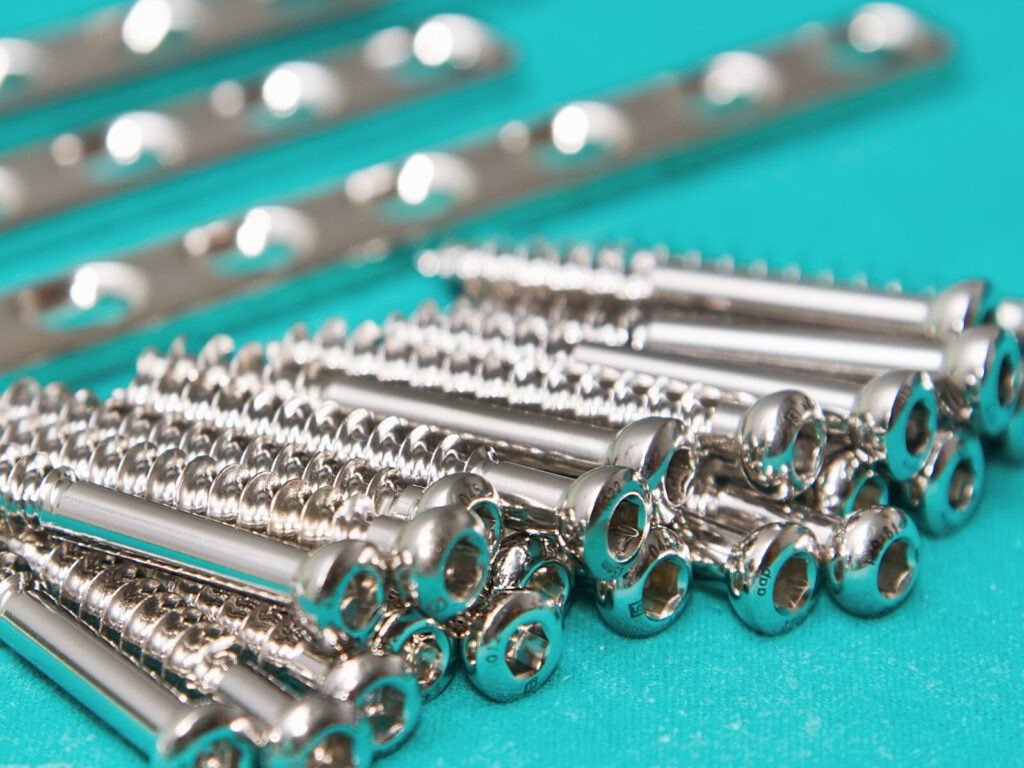
- Driving torque: This test determines how much force a screw takes to drive into a known substrate. The Family of Companies has custom test beds to perform this specific type of testing. Customers can use the data gained from this testing to optimize designs and guarantee they are not overloading the bone.
- Pull-out: Pull-out testing determines a screw’s resistance to being pulled out of its substrate. The medical testing labs often carry out this test after a driving torque test. Doing so helps customers better understand the level of hold their screw has inside a bone substrate.
- Shear, fatigue, and lever: These tests assess how much force a screw can withstand when moving or levering due to a plate or rod. This testing determines how strong the fixation is without the substrate present.
Accreditation and Quality Standards
The ATS Family of Companies holds an ISO/IEC 17025:2017 accreditation (A2LA Cert No. 2142.01) for the highest number of medical device testing methods of any United States company. Our lab performs medical device testing and evaluations in accordance with recognized ASTM and ISO standards appropriate to the testing application. Both of these qualifications set the Family of Companies apart from our competitors by reducing costs, establishing credibility, and improving efficiency.
Our medical device testing labs that equip manufacturers with the tools to get it right from the start. We can help medical device manufacturers get their products on the market faster and for less without compromising quality and safety.
Contact Us
Click here to submit a request form online. If you have any questions about our capabilities, please call +1 (888) 287-5227 to speak with our representatives.